Collaborative Robots
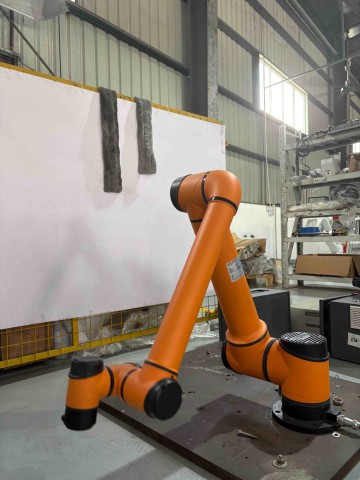
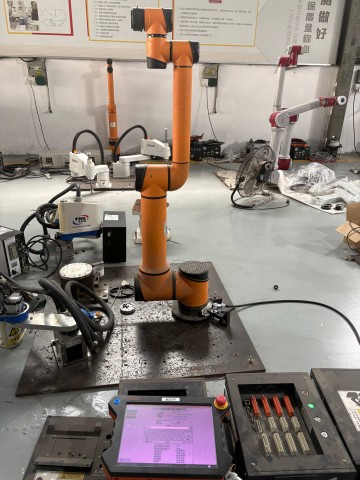
A collaborative robot is built to work next to people rather than behind a fence. The arm is light, the joints are torque-limited, and most models can be guided by hand to teach a path instead of being programmed point by point. For a shop that runs high-mix, low-volume work, that changes the economics: setup drops from hours to minutes, and the cell can be moved to the next job on a wheeled stand.
This group covers the platforms we see most often in the field: Universal Robots UR3, UR5 and UR10 on CB3 controllers, AUBO i5, i7 and i10, and the ABB YuMi dual-arm unit. Payloads sit between 3 kg and 10 kg, which suits machine tending, screwdriving, inspection, gluing and light assembly. The YuMi is a different animal - two 0.5 kg arms on one base, built for small-part assembly where two hands work together.
Collaborative does not mean no risk assessment. Every cell still needs one, because the gripper, the workpiece and the fixture are not collaborative - they are sharp, hot or heavy, and the arm can still push a hand against a surface. The controller generation matters too: CB3 units run the older PolyScope 3 interface and have fewer I/O options than the e-Series, which affects how easily the arm talks to your machine tool or conveyor. Check what the controller supports before you plan the integration.
Tell us the task, the part weight including the gripper, the reach you need and whether the arm will share space with an operator or run inside a guarded cell. If you already have a UR program or a URCap in mind, say which one - compatibility depends on the software version on the controller. We will confirm the model and the controller generation before quoting.